
That same afternoon, I read that OpenAI had closed a funding round at an $852 billion valuation. Still a private company. Not yet publicly traded.
I sat with both of those facts at the same desk in Georgetown, Delaware, where I sell houses for a living. The tool I'd just used felt like a miracle of free intelligence. The company behind tools like it was being valued like a sovereign nation. I couldn't make both things true at the same time. Or I could, but not in the way I'd been thinking about it.
A few weeks earlier, I'd come across a remark from Dario Amodei, the CEO of Anthropic, one of the leading AI companies. He was describing the scale of wealth artificial intelligence could create, so vast that some of its architects may become the first trillionaires in history. Then he said this: "You're going to get a mob coming for you if you don't do this in the right way."
Not a protester. Not a politician. The man building the thing, telling the other people building the thing that if they don't figure out how to share what's coming, the public will come for them.
He also predicted that half of all white-collar entry-level jobs will be significantly disrupted within one to five years. He published a 19,000-word essay calling AI "a serious civilizational challenge." Then he went back to work on it. Sam Altman told investors that we've spent centuries learning to manage scarcity and now need to quickly learn the opposite. Then he admitted that nobody knows how to do that.
These people are making two promises at the same time, and I have spent months trying to understand how both of them can be true.
Promise one: AI will create abundance. Intelligence will become cheap, then cheaper, then practically free. The cost of cognitive work will collapse. Society will be wealthier, healthier, and more productive than at any point in human history.
Promise two: the companies building AI are worth more than almost anything that has ever existed. Bridgewater estimates that Alphabet, Amazon, Meta, and Microsoft alone will spend roughly $650 billion on AI infrastructure this year. Nvidia became the most valuable company on Earth by making the chips that power all of it. The Magnificent Seven now make up roughly a third of the entire S&P 500.
Those are not the numbers of a technology that makes things free. Those are the numbers of a toll road being built across the future.

The easy response is to call it hypocrisy. I think it's something more important, a mechanism, and once you see it, the whole picture comes into focus.
AI does not eliminate scarcity. It moves scarcity upstream.
That single idea is the key to everything confusing about this moment.
At the point of use, where you and I sit, intelligence is getting radically cheaper. I can ask an AI to analyze a property, draft a contract, summarize a report, or build a marketing campaign, and the cost is fractions of a cent. That's real. That abundance is not a fantasy.
But producing that intelligence, distributing it, integrating it into the systems that run the world? That has never been more expensive. The chips cost billions to design. The data centers cost billions to build. The energy to run them is straining power grids. The talent to manage it all commands the highest salaries in the history of professional work.
What you get is a world where intelligence feels free to the person using it and costs a fortune to the person providing it. The marginal cost, what it takes to serve one more query, trends toward zero. The fixed cost, what it takes to build and maintain the infrastructure, is exploding. And the companies that control that infrastructure capture value at a pace we have never seen, precisely because they sit between the cheap intelligence and the people who need it.
The product gets cheap. The tollbooth gets expensive. Whoever owns the tollbooth collects from everyone who passes through.
You don't need history books to recognize this pattern, though the history is there if you want it. Electricity dropped the cost of lighting a room by more than 90 percent in a generation, and the wealth it created flowed to the people who owned the power plants and transmission lines. The internet gave everyone a voice and a storefront, and it also produced a handful of companies that now account for a third of the stock market. In both cases, the technology was abundant almost immediately. The broadly shared prosperity took decades, and it only came after political fights that most people have already forgotten.
But I watched this same pattern play out in my own industry, in real time, close enough to touch.
Twenty years ago, home values were locked inside the MLS, accessible only to licensed agents. Zillow promised to change that. It would democratize real estate information. Every homeowner could see what their property was worth. Every buyer could search without a gatekeeper.
And it delivered. The information became free. That was real, and it mattered.
But Zillow didn't replace the real estate agent. It became the front door to real estate, then sold that attention back to agents as paid leads. The information was free. The distribution was not. Agents who once built their business through expertise and relationships now paid Zillow for the right to talk to the people Zillow had attracted using the agents' own listings. The consumer got transparency. Zillow captured the tollbooth.
Then Zillow tried to go further. It launched an iBuying program, attempting to automate the transaction itself, to cut out the human judgment entirely. It lost hundreds of millions of dollars and shut the whole thing down. The physical layer of real estate, the local knowledge, the repair decisions, the crawl space that smells wrong, the seller who needs the truth delivered by someone she trusts, could not be compressed into an algorithm.
I think about that sequence constantly. Because the human work that can't be automated becomes simultaneously more essential and harder to get paid for.
I've worked alongside agents for years who can walk into a house and tell you within minutes what it will sell for. Not from a comp analysis. From ten thousand conversations with buyers, from reading body language at showings, from the accumulated weight of being present in rooms where real decisions get made. AI can now draft the listing copy, prepare the contracts, run the market analysis, and organize the day. It does in seconds what used to take hours.
What AI cannot do is sit across from a seventy-year-old widow selling the home where she raised her children and find the right words to tell her that the kitchen she loves is going to cost her thirty thousand dollars on the open market. That takes judgment born from years of practice. That takes presence. That takes a human being who has learned how to tell people the truth without breaking something.
The question is whether the economy will value what that agent has. History is not encouraging. When routine work gets automated, economies have not tended to pay more for the human judgment that remains. They've tended to employ fewer humans. The weavers who survived the power loom didn't get raises. There were just fewer weavers.
There is a counterargument worth taking seriously. Compute costs are falling. Open-source models are proliferating. Meta gives away its AI for free. Isn't it possible that the infrastructure concentration is temporary, that the tollbooth will erode just like the marginal cost has?
Maybe. Software has a long history of commoditizing. But the physical layer underneath AI is different from the software layer on top. You can copy a model. You can't copy a data center. You can open-source an algorithm. You can't open-source a power grid. The trillion-dollar moat around the major AI companies isn't their code. It's their chips, their energy contracts, their land, their relationships with the governments that approve construction permits and power allocations. The atoms, not the bits. And atoms have never been subject to the same democratizing forces as software.
Meanwhile, the early data is arriving. Stanford researchers, using payroll data from ADP, found that entry-level employment has already declined in the roles most exposed to AI automation, with young workers in the most affected occupations showing a roughly 16 percent relative employment decline. That's not proof of the whole future. But it's exactly the kind of early signal that societies tend to regret ignoring.
I am a first-generation college graduate. I grew up in a middle-class family where nobody had a playbook for what came next, but the ladder was there if you were willing to look for it. The first rung was a lawn care business as a teenager. Then political campaign work. Then education. Then real estate, where I spent years doing the unglamorous work that nobody sees: cold calls, open houses, door knocking, learning to read people by sitting across from hundreds of them in living rooms that smelled like coffee and anxiety.
I remember my first listing presentation. I was twenty-five. I sat across from a couple in their sixties and tried to explain why their home was worth less than they believed. I had the data. I had the comps. I had rehearsed. And I watched their faces close like a door. I lost the listing. But I learned something that no market analysis could have taught me. The truth has to be earned before it can be delivered, and that earning it takes years of showing up, getting it wrong, and showing up again.
Every one of those rungs required repetitive, structured tasks that forced me to build judgment by doing things I could not yet fully understand. Writing reports taught me to think clearly. Managing schedules taught me to prioritize under pressure. Analyzing data taught me to see patterns before I could name them. The tasks were never the point. The point was the person I became while doing them. But the tasks were the doorway. You couldn't get to the other side without walking through.
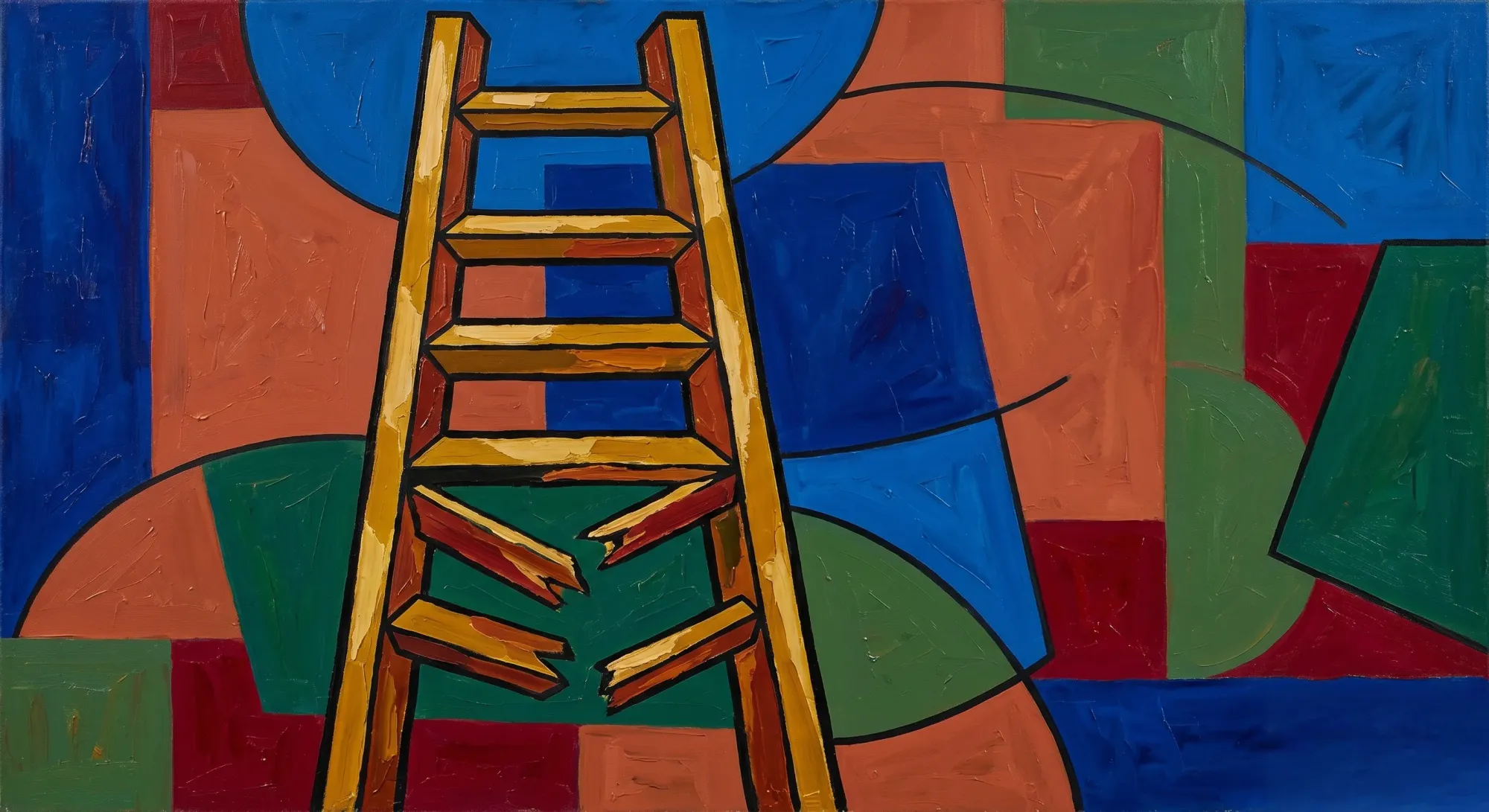
That is what I fear AI may take first. Not expertise. Apprenticeship. The ordinary, repetitive, sometimes tedious work through which people become competent enough to do the extraordinary work that remains.
But I have to be honest. That same technology has given me more reach than I have ever had. I am running a brokerage, building a technology company, writing this newsletter, raising two kids, showing up for my wife, volunteering in my community, and the reason I can hold all of it at once is that AI has collapsed the cost of building, not just the cost of consuming. Work that would have required a department and a fundraise five years ago, I can do with judgment and a laptop. That leverage is not theoretical. I hold it in my hands every day.
But I could only pick it up because I had already spent fifteen years building the judgment to know what to do with it. AI is the most powerful amplifier ever created. It is not a substitute for the foundation it amplifies. And that foundation — built from repetition and unglamorous early work — is exactly what's being automated away.
The people who already have the judgment are about to become the most leveraged individuals in economic history. The question is what happens to the people who haven't built it yet.
A society can survive inequality. What it can't survive is the disappearance of ladders — not because AI is malicious, but because the economics of abundance and the economics of opportunity are not the same economics, and nobody has built the bridge between them yet.
My daughter is ten. Some nights, after the house goes quiet and the screens are off, I think about what I'm building and who it's for.
She is smart and curious and stubborn in a way that will serve her well. By the time she's twenty-two, the tasks that once defined an entry-level career, the reports, the analyses, the project coordination, the proposals that teach you how an organization thinks, will largely be handled by systems that cost pennies to run. The doorway I walked through will be narrower than it has ever been. Maybe it will still be there. I don't know. That uncertainty is not something I can resolve with an argument. It sits in a different place than arguments sit.
I am not worried about whether she'll earn a living. I am worried about whether she'll get the chance to become someone through work — to be shaped by the doing, the way I was, before the doing disappears.
I am building a technology company. I use AI every day. I believe in it deeply enough to stake my family's livelihood on it. And I cannot tell my daughter with certainty that the world it creates will have a clear place for her to begin.
That is not a contradiction. That is fatherhood in 2026.
Abundance for consumers can coexist with precarity for producers. They are the same phenomenon viewed from different positions. The cost of nearly everything intelligence touches will fall. At the same time, the pathways by which ordinary people build careers, earn bargaining power, and find their way into the middle class can be hollowed out. The products get better. The paths get narrower. The price of intelligence falls. The price of belonging stays the same.
The test of this technology is not whether it creates abundance. It will. It already is.
The test is whether the abundance arrives in time for the people who need it most, or only after the concentration has already hardened into something permanent. Whether the gains reach the real estate agent in Georgetown and the twenty-two-year-old searching for a first rung and the small-business owner trying to decide if AI is a tool or a replacement.
The people building this technology see the problem clearly. They've said so in their own words. But in every previous technological revolution, seeing the problem and acting on it were not the same thing. The gains arrived first. The distribution came later, sometimes decades later, and only after ordinary people demanded it.
If real estate teaches you anything, it's this: when someone promises you something for nothing, someone else is paying a price you can't see yet. The lunch is never free. But it can be extraordinary, if there are enough seats at the table before the people who own the kitchen decide they'd rather eat alone.
The kitchen is open. The meal is being prepared. I can smell it from here. And I am not sure there are enough chairs.