It means safety. It means knowing where you stand.
And lately, I've been thinking about how easily that need can be turned against us.
My grandfather raced harness horses before he became a salesman. He wasn't union, wasn't wealthy, wasn't connected. Just middle class, a phrase that used to mean something solid. My parents were the same. I'm a first-generation college graduate, and I've done well since. Better than well, if I'm honest. I've built companies, created jobs, accumulated wealth. I believe in capitalism. I believe in self-determination, the idea that your choices matter, that agency is real, that the person in the mirror is responsible for what they build or fail to build.
I'm telling you this because what follows might sound like it comes from someone who doesn't. I'm not interested in tearing down the system. I'm interested in seeing it clearly.
History As Warning
Recently, at an event with many people I respect, I found myself at dinner with a man that has an unusual inheritance. His great-grandfather was Paul von Hindenburg, the German president who appointed Adolf Hitler as chancellor in 1933. He didn't have to. He could have refused. He made a calculation that he could control the situation, use the populist energy for his own ends, contain the extremism.
He was wrong.
This man, now an American citizen, has dedicated himself to making sure it doesn't happen again. Not in the country his ancestor failed. Not in the country he's chosen. His presence reminded us that history warns us, if we're willing to listen.
I keep thinking about what it means to carry that name. To choose, rather than hide from it, to stand in rooms full of Americans and say: my family made a catastrophic miscalculation once. I'm here to help us recognize the test when it comes again.
The Power of Simple Math
Here's where it gets complicated for me.
I believe in markets. I believe in competition. I believe that capitalism, for all its flaws, has lifted more people out of poverty than any system in human history. I believe that when you let people own the fruits of their labor and make voluntary exchanges, something close to magic happens.
But I also know math.
Compound interest is a miracle when it works for you and a trap when it doesn't. Wealth concentrates over time. Not because wealthy people are evil, but because that's what the math does. Money makes money. Advantages compound. Three generations of small edges become a canyon between those who have and those who don't.
This isn't a moral judgment. It's physics. And if you don't design a system to account for it, you get aristocracy by another name.
I love technology. I've built businesses on it. I believe AI could bring abundance we can barely imagine: breakthroughs in health, science, energy, access to knowledge that was once reserved for the privileged few. The optimist in me sees a future where the average person has capabilities that would look like superpowers to my grandfather.
But I also watch what social media does to my kids' generation. I've seen my daughter's face after scrolling, the way she sets the phone down, looking somehow less herself than when she picked it up. Ten years old and already learning that her attention is a product being sold.
I see how a single billionaire can buy a platform and reshape what millions of people see, what they fear, who they blame. I watch algorithms serve up outrage like a slot machine serves dopamine, training us to hate each other in exchange for engagement metrics. I understand that the same tools that could liberate us can manipulate us, and that the people who own those tools have interests that may not align with ours.
Technology is not good or evil. It's a lever. The question is always: who's holding it, and what are they trying to move?
The Power of Distraction
There's an old pattern in history. When the gap between those at the top and everyone else becomes untenable, the people at the top face a choice. They can give something up: accept reforms, redistribute power, recommit to the social contract. Or they can change the subject.
They almost always try to change the subject first.
The subject changes to immigrants. To foreign enemies. To demographic panic. To cultural threats. The wages stagnate, and somehow the conversation becomes about pronouns. The housing market locks out a generation, and somehow the debate becomes about what books belong in libraries. A billionaire pays a lower tax rate than a teacher, and somehow the outrage flows toward migrants being loaded onto planes in predawn raids. We're told that criticizing a foreign government's policies makes us bigots, that certain populations declining is an emergency, that the real threat is the neighbor who votes differently.
I'm not saying these issues don't matter to people who raise them. I'm saying: notice what you're not discussing while you're discussing them. Ask who benefits from your attention being there instead of here.
I've met presidents, governors, members of Congress. I know several billionaires. Most of them are not bad people. They're often brilliant, usually charming, frequently generous. They love their families. They fund hospitals and universities. They believe, most of them, that they're on the right side.
That's precisely what makes this so hard to see.
The system doesn't require villains. It requires people following incentives. When you have enough resources to shape the incentive structure itself, to fund the think tanks, own the platforms, bankroll the candidates, you don't need to be malicious. You just need to be rational. The architecture does the rest. I've been one of those people. I probably still am.
Most people, I believe, are good. Some are misguided. Some are simply unaware of how their choices aggregate into outcomes they'd never consciously choose. And yes, some are genuinely bad actors, subscribed to philosophies that treat other humans as obstacles or enemies. But the system doesn't run on the bad actors. It runs on the good people who don't see what they're part of.
Humans run on story. Give someone a framework that explains their suffering and names their enemy, and they'll follow it further than reason would ever take them.
The story being told right now has vivid villains and a missing chapter. The villains are always visible from your front porch: the immigrant, the activist, the person who prays or loves differently. The missing chapter is about who funds the storytellers. Who owns the platforms. Who benefits when your eyes stay fixed on your neighbor instead of lifting upward.
The Power to Choose
I believe in personal responsibility. I believe your choices matter, that victimhood is a trap, that agency is the foundation of a meaningful life. I also believe that powerful forces are working to capture your attention, direct your anger, and ensure that the one thing you never question is who's really writing the rules.
Both things are true. You are responsible for your life. And you are being manipulated.
The question is whether you can hold both thoughts at once, whether you can take ownership of your future while also seeing clearly the game being played around you.
We've just turned the calendar into a new year. There's something clarifying about that, a built-in moment to ask what we're carrying forward and what we're ready to set down. I don't know about you, but I'm tired of being sorted into tribes. I'm tired of the efficient delivery of rage to my pocket every morning. I'm tired of watching good people sharpen themselves against each other while the architects of their frustration remain comfortably out of frame.
But I'm not without hope. I've seen too much to believe that awareness changes nothing. I've watched people, once they connect the dots, become impossible to fool again. I've watched communities rebuild trust across lines that were supposed to be uncrossable. I've sat in rooms where former adversaries discovered their interests were aligned all along, that the fight they'd been having was a distraction from the one that mattered.
History warns us. But history also shows us that these patterns can break. That people, when they see clearly, choose each other over the story they've been sold.
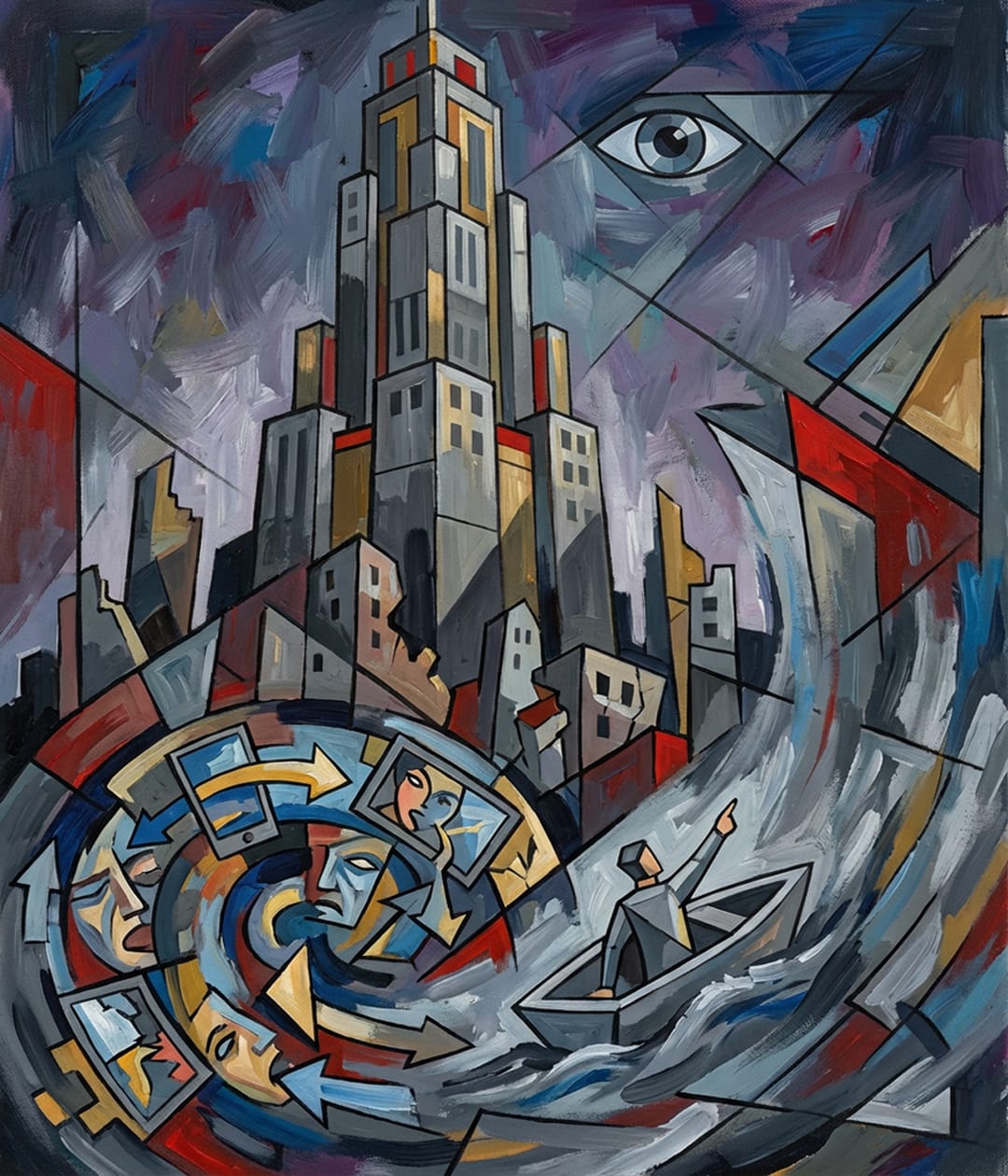
A man carrying his great-grandfather's name is willing to stand in American rooms and sound the alarm. The least I can do is notice, and point, and hope that you'll look.
Look up. Ask who benefits. Remember that the person next to you, whoever they are, is probably navigating the same rising water.
That's where clarity starts. That's where anything good begins.
Here's to a year of seeing clearly.