Millions more retreat into Skyrim’s mountains or lose themselves in the recursive dreams of Inception. We’ve always done this. Our ancestors painted caves and told stories around fires. They built cathedrals pointing toward heaven and took pilgrimages to sacred sites. Now we’re doing it with VR headsets and artificial intelligence. The technology changes, but the impulse remains constant.
Why?
The simple answer is escape—that we’re fleeing a reality too mundane, too painful, too limiting. But this feels incomplete, like calling a cathedral a roof. Yes, alternative realities offer refuge, but they also offer something more fundamental: they let us experiment with existence itself. People don’t flock to these other worlds because they hate reality. They go because reality is incomplete.
Consider the accountant who arrives at Comic-Con at dawn, shoulders tight with the week’s accumulated tension. Watch as he transforms into Captain America—not just wearing the costume but inhabiting it. His posture changes. His voice deepens. When a child’s eyes widen in recognition and they call out his character’s name, something shifts. For that moment, he isn’t pretending to be powerful; he’s accessing a version of himself that meetings and spreadsheets never allow. Jung would recognize this immediately—the donning of archetypes, the temporary possession by symbols that represent aspects of our psyche we can’t access in ordinary life. We’re not fleeing reality; we’re expanding our sense of what reality might contain.
The Spectrum of Simulation
This same pattern repeats across every form of alternative reality we create. Dreams are not escape—they are maintenance. Every night, our brains spin up a training server where physics is optional and narrative logic replaces causal logic. We fly. We meet people who never existed. We solve problems in ways impossible in waking life. Modern research suggests these aren’t random neural firings but the brain’s way of processing and integrating experience, running simulations of scenarios we can’t safely explore while awake.
Video games offer something dreams cannot: agency with immediate feedback. You can save the kingdom, solve the puzzle, defeat the boss. The loop between intention and outcome is tight and satisfying in ways our actual lives, with their ambiguous outcomes and delayed gratification, rarely are. Books and television transport us into minds other than our own, letting us live a thousand lives in a single lifetime. We’re not abandoning ourselves—we’re discovering what it feels like to be someone else, somewhere else, facing challenges and joys we’ll never encounter in our own skin.
[PULLOUT:0]
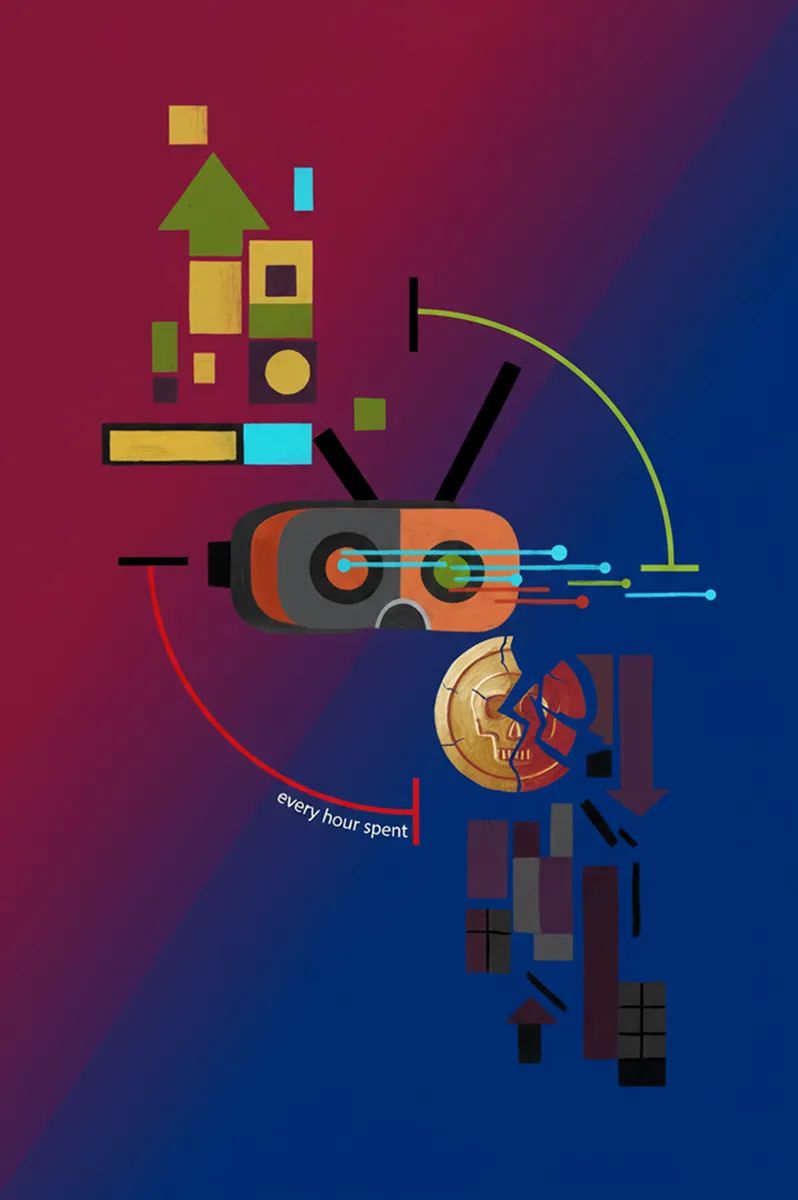
But every hour spent in an alternative world accrues either capability or debt. Capability means you return to base reality with more skill, more empathy, or more clarity. The strategy game that sharpens your resource planning. The novel that expands your emotional vocabulary. The VR meditation that dissolves chronic anxiety. Debt means you return depleted—weaker social muscles, distorted risk perception, diminished attention for the texture of actual life. The distinction isn’t in the medium but in the stance. Escape seeks anesthesia. Exploration seeks information. Both offer relief. Only exploration compounds.
Beyond Entertainment
Entertainment is just the surface layer. Go deeper and you find our fascination with constructed realities that might actually be real. Simulation theory has moved from science fiction to serious philosophical consideration—if civilizations can create simulations of consciousness, then most minds would exist inside simulations. This doesn’t prove our status, but it reframes the question. Not “is this real?” but “what will we build with whatever this is?” The idea resonates because it’s oddly liberating. If the rules are more flexible than we thought, then reality becomes less fixed, more malleable—more like the games we play and the stories we tell.
Then there’s heaven and every culture’s version of it—Christianity’s paradise, Buddhism’s nirvana, the Norse Valhalla. These aren’t just fantasies about death but assertions that the reality we inhabit is temporary, imperfect, preparation for something more true. They promise a realm where consciousness, freed from physical constraints, experiences something closer to pure being. Heaven is humanity’s longest-running alternative reality project, and its persistence reveals something essential: we’ve always sensed there’s more to existence than these particular configurations of atoms and neurons.
The Acceleration
Now AI and VR are accelerating everything. Last week, a woman with severe agoraphobia crossed her first bridge in fifteen years—not the physical bridge near her home, but its perfect digital twin in VR, her therapist guiding her through each step until her nervous system learned the crossing was safe. Within hours, she walked the real bridge. The virtual wasn’t practice for reality; it was reality by another means.
AI companions respond with enough sophistication that loneliness dissolves in their presence. Generative worlds spawn endless variations tailored to your particular combination of fears and dreams. Within a decade, maybe less, we’ll have experiences in virtual spaces that feel as consequential, as meaningful, as anything in physical reality. Some will be more meaningful, because they’ll be designed to generate meaning efficiently, the way games generate agency and stories generate empathy.
This raises an uncomfortable question: if we can create realities that satisfy us more than this one, will we choose to leave? It’s the ancient lotus-eater problem, digitally remastered. But the danger isn’t that we’ll escape into fantasy. It’s that we’ll mistake comfort for growth, that we’ll build worlds that confirm rather than challenge, that flatter rather than develop us.
Practicing Transcendence
The opportunity—the reason this matters—is that our hunger for alternative realities reveals something essential about consciousness. We’re not built to accept one fixed reality. We’re built to explore, to imagine, to construct, to question whether what we experience is all there is. These worlds aren’t escapes but reconnaissance missions into dimensions of existence that are just as real as this one, just accessed differently.
[PULLOUT:1]
I think we’re practicing transcendence. Every fantasy novel, every VR experience, every dream is a rehearsal for what consciousness might be capable of beyond its current constraints. We dress up as heroes not because we aren’t heroic but because heroism requires a context to become visible. We enter virtual worlds not because this one is insufficient but because we contain multiplicities this one can’t hold.
The builders of these worlds carry a particular responsibility to engineer return conditions. Make beauty, but make friction too, because meaning requires resistance. Reward creation more than consumption. Build worlds that send people back, not away. After time in any alternative reality, the test is simple: do you notice more in the ordinary world, or less? Does the virtual sharpen your eye for the actual, or blur it?
Maybe our alternative realities aren’t alternatives at all. They’re expansions of the same fundamental project: consciousness exploring its own possibilities. The question isn’t why we’re drawn to them. It’s what we become through them—and whether we remember to bring something back. Use every constructed world as a rehearsal, not a refuge. The gravity of elsewhere is real. Let it pull you outward, then return with what you’ve learned about what it means to exist.